News

Making sense of human interaction benefits from communicative cues

October 28, 2020
Decorative image

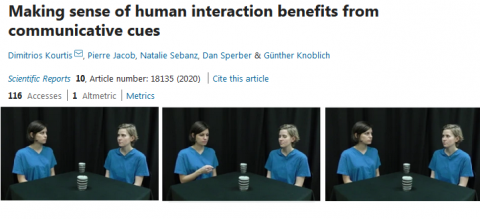
We investigated whether communicative cues help observers to make sense of human interaction. We recorded EEG from an observer monitoring two individuals who were occasionally communicating with each other via either mutual eye contact and/or pointing gestures, and then jointly attending to the same object or attending to different objects that were placed on a table in front of them. Our results show that observation of communication “opens up” the mind to a wider range of action possibilities and thereby helps to interpret unusual outcomes of social interactions.

Efficiency is prioritised over fairness when distributing joint actions

October 28, 2020
Decorative image

Individuals have a drive towards maximising action efficiency, which is reflected in action choices that minimise movement costs to reach a goal. In joint actions, actors prioritise joint efficiency or coefficiency, maximising the utility of the joint action even if this comes at a cost to themselves. However, it remains an open question whether actors are willing to unilaterally sacrifice their partner's individual efficiency for the greater good, when forcing a partner to incur additional costs may be interpreted as unfair.
Research in Vienna

September 23, 2020

We are currently recruiting participants in Vienna to take part in our studies. Click here to learn more

Adaptation to unstable coordination patterns in individual and joint actions

May 11, 2020
Decorative image

Previous research on interlimb coordination has shown that some coordination patterns are more stable than others, and function as attractors in the space of possible phase relations between different rhythmic movements. The canonical coordination patterns, i.e. the two most stable phase relations, are in-phase (0 degree) and anti-phase (180 degrees). Yet, musicians are able to perform other coordination patterns in intrapersonal as well as in interpersonal coordination with remarkable precision. This raises the question of how music experts manage to produce these unstable patterns of movement coordination.

Effects of a partner's task on memory for content and source

Decorative image

Our new paper shows that a task-partner can facilitate retrieval of information and this reflects humans' tendency to map out their partners' knowledge states and to prioritize information relevant to their partner.