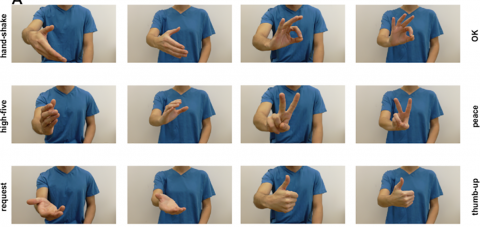
The social interactions that we experience from early infancy often involve actions that are not strictly instrumental but engage the recipient by eliciting a (complementary) response. Interactive gestures may have privileged access to our perceptual and motor systems either because of their intrinsically engaging nature or as a result of extensive social learning. We compared these two hypotheses in a series of behavioral experiments by presenting individuals with interactive gestures that call for motor responses to complement the interaction and with communicative gestures that are equally socially relevant and salient, but do not strictly require a response from the recipient.